The Norwich Print FairPolly Cruise's Knot!
Art Snippet 1Art Snippet 2Art Snippet 3Art Snippet 4
home  •  about  •  artists  •  shows  •  techniques  •  links events  •  news  •  contact  •  register

What Is An Original Print?

Introduction
Relief Print

  Linocut
  Wood Engraving
  Woodcut

Intaglio

  Engraving
  Mezzotint
  Dry Point
  Etching
  Aquatint

Screen Print
Lithographic
Collagraph
Monoprint
Digital Printing
 
Glossary

Intaglio

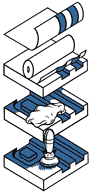
Inking Up
An etched / engraved block being inked, wiped, printed & the print being removed.

An Intaglio Print is made by cutting into a flat surface by hand as in 'engraving' or by using acid to burn into a metal plate as in 'etching'. Ink is rubbed into the hollows and the surface wiped clean of excess ink. Dampened paper is then placed over the inked plate and is passed through a rotary press, forcing the paper into the inky hollows, leaving the paper embossed by the plate.
The depth and density of the pits and hollows controls the tone of the finished print.

Engraving

With engraving, sharp pointed tools and roulettes (small wheels or rollers with indented or sprocketed teeth) are used to cut lines making pits and hollows in the surface of a metal plate.

Mezzotint

Ernst Nicol - Memento MorayUsing a Mezzotint rocker, which is a flat steel blade with a fine serrated edge, thousands of tiny indented holes are evenly made over the entire surface of a copper plate. This will print as an even, rich, velvety black.

Working from dark to light, a tonal design is produced by scraping and polishing the surface of the indented plate with a scraper and burnisher.

The deeper the indented areas remain, the darker it will print. Where the plate is polished smooth, no ink will adhere and so will appear as high lights.

Drypoint

Nicola Slattery - Thunder Hill HareAs with engraving, a sharp pointed steel tool is used to inscribe directly into the surface of a plate. With Drypoint however not only is a line inscribed into the surface, but a burr is pushed up, like the furrow of a ploughed field. When the plate is inked and wiped, both the inscribed mark and the burr hold the ink, printing as a thick, velvety line.

Etching

Marilyn Jeffries - Quebec WellsA flat metal plate is first coated with an acid resistant ground, which consists of bees wax, bitumen and resin. The plate is gently heated and the wax ground is melted on to the surface and spread evenly in a thin layer using a hard wearing roller or dabber.
The plate is allowed to cool, the wax hardens and is then ready for the design to be scratched through the hardened coating, exposing the metal below.

Alternatively or in combination with, a bitumen based varnish (or stop out varnish) can be used to paint out the areas of the plate you do not wish the acid to affect.

The whole plate is then immersed into the acid. This burns or etches only the exposed areas of the metal plate where the design has been drawn.
The longer the plate remains in the acid, the deeper the lines are etched. The depth and density of the etched lines controls the tones of the print.

Aquatint

Aquatint
1-Even layer of powered resin being dusted over the plate surface.
2-Plate being heated, resin melting.
3-Acid biting between grains of resin.
4-resin removed, ready for proofing.

Aquatint is used to etch large areas of even tone. When large areas are etched, the acid bites evenly over the open area, creating a dark line around the edge when the plate is inked and wiped, this is especially so with either copper or zinc.

To create the desired tone, a fine even layer of powdered resin, which is acid resistant, is dusted over the surface of the plate. When the plate is heated, the resin melts and fixes to the plate.

Starting with the high lights, the design is painted out with acid resistant stop-out varnish. The acid bites into the metal plate between the individual grains of resin.

Martin Mitchell - CloistersThe tones are stopped-out and etched in stages, the longer in the acid the deeper the etch, therefore the darker the tones.